Publish on by Kingdom Cute Luxury Hair Salon
- Start your layered haircut for black hair with a two-style brief
- Account for shrinkage before choosing the shortest layer
- Choose layer placement that supports both silhouettes
- Preserve the perimeter when fullness matters
- Decide how much crown volume you want
- Set a separate boundary for face-framing pieces
- Agree on the cutting approach during your consultation
- Build two realistic styling routines
- For your natural or textured look
- For your straight or stretched look
- Check the haircut after your first normal wash
- Use a specific request instead of “just add layers”
- Frequently asked questions
- Bring both looks to your Kingdom Cute consultation
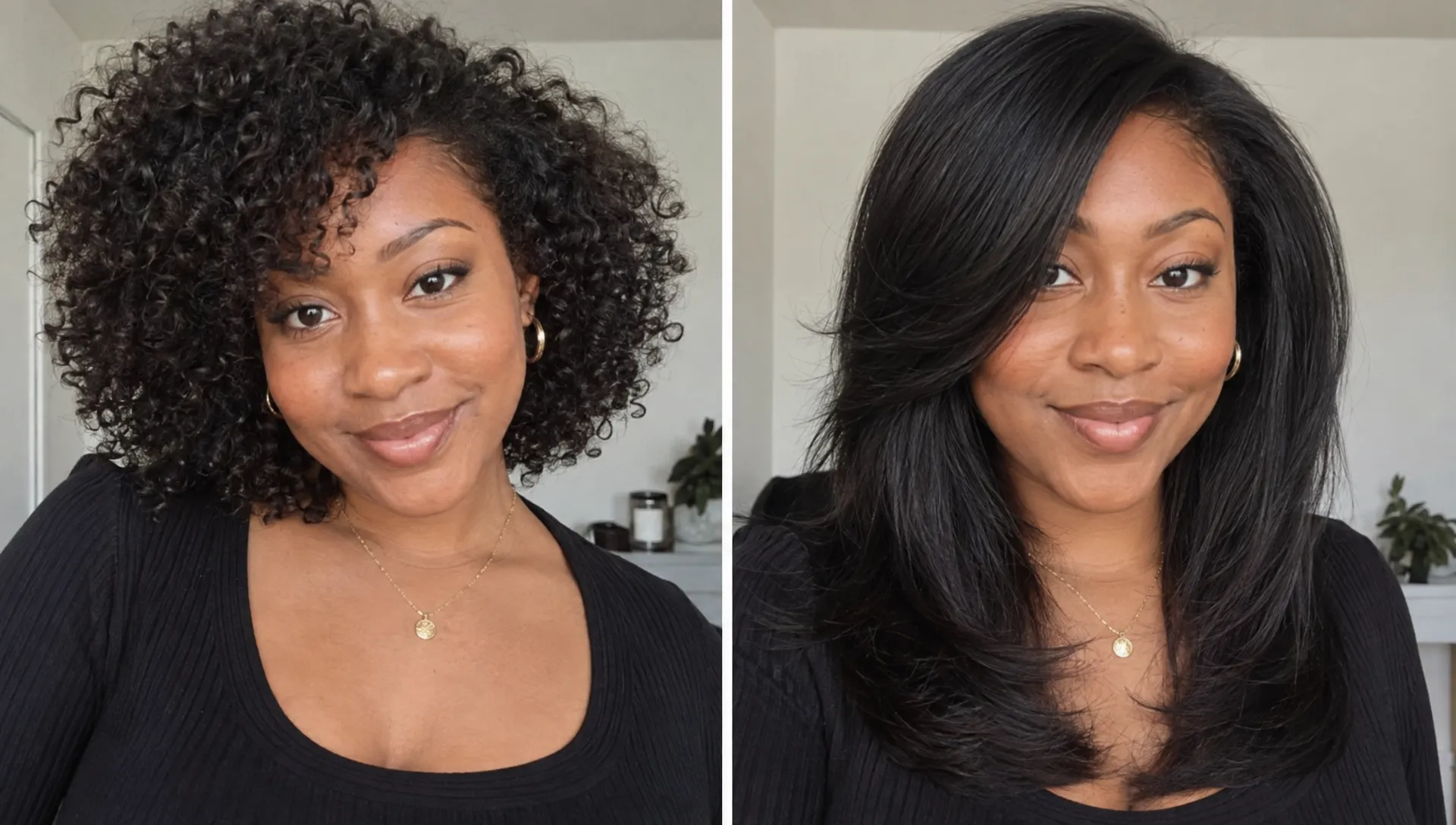
You might wear your curls most weeks, then switch to a silk press for a special occasion. A layered haircut for black hair needs to account for both looks, especially when shrinkage changes where the shortest pieces land. The goal is not to make your textured and straightened hair look identical. It is to create two shapes you enjoy without sacrificing fullness or making either style difficult to maintain.
Start with the styles you actually wear, not just the haircut in your inspiration photo. Black hair includes many textures, densities and strand thicknesses, so there is no single layer pattern that works for everyone. Your stylist needs to know how your hair behaves naturally, how you stretch it and which look matters most in your everyday routine.
Start your layered haircut for black hair with a two-style brief #
“Curly and straight” is a useful starting point, but it leaves out details that affect the cut. A wash-and-go can sit differently from a twist-out. A stretched blowout can hold more volume than a sleek silk press. Name the two finished styles you want your haircut to support.
Then choose your priority. If you wear natural curls most of the time, their shape should lead the conversation. If you regularly wear your hair straight, you may care more about a substantial bottom edge and smooth transitions between layers. A layered haircut for black hair becomes easier to plan when you identify a primary look and the compromises you can accept in the second.
Bring photos of your own hair in both states, along with inspiration images. Use this comparison to prepare:
| Planning question | Natural or textured style | Straight or stretched style |
|---|---|---|
| What shape do you want? | Rounded, elongated or fuller at the crown | Smooth, softly curved or voluminous |
| What must stay long enough? | Front curls, sides or pieces used in an updo | Face-framing pieces, ponytail sections or ends |
| What do you want to avoid? | Short curls springing above your preferred length | Thin-looking ends or obvious gaps between layers |
| What styling do you actually do? | Wash-and-go, twist-out or braid-out | Blowout, silk press or roller set |
Treat inspiration photos as a conversation tool rather than a promise. Differences in density, curl pattern and styling can change the finished silhouette even when the layer placement is similar.
Account for shrinkage before choosing the shortest layer #
Shrinkage is not uniform across every head, or even across one head. Your crown may contract differently from your nape, while your front pieces may have a looser or tighter pattern than the sides. A straightened reference photo cannot show those differences.
Ask your stylist to assess where your hair sits in its usual textured state. Photos taken after your normal wash routine are helpful, particularly if you arrive with stretched hair. They show how the front, crown and perimeter behave without asking your stylist to guess from straightened length alone.
The shortest layer in a layered haircut for black hair should be discussed in terms of where it will sit in each style, not just how many inches will be removed. A piece that reaches your cheek when straight could sit much higher when curly.
There is no dependable universal shrinkage percentage to apply to every section. Your stylist can use your actual hair behavior to guide the decision. For more background on texture-specific shape, see how layers can support curly hair without losing definition.
Choose layer placement that supports both silhouettes #
Preserve the perimeter when fullness matters #
The perimeter is the bottom outline of the haircut. Keeping enough hair along that edge can help a straightened style look substantial rather than wispy. It also gives your textured style a clear overall shape.
If your ends already look sparse, ask whether they need evening up before adding more layers. Layers redistribute the appearance of fullness; they do not create additional hair. Removing too much length through the interior can make an already thin bottom edge more noticeable.
Decide how much crown volume you want #
Shorter crown layers can create a fuller-looking upper silhouette, but the effect depends on texture, density and styling. On tightly curled hair, those pieces may sit considerably higher than they do in a blowout.
For a layered haircut for black hair worn in two states, discuss whether you want noticeable crown volume in both or mainly in your textured look. Longer, more gradual layers may be a useful starting point when preserving length is the priority. More pronounced layering can suit someone who welcomes a bigger difference between the two shapes.
Set a separate boundary for face-framing pieces #
Face framing deserves its own conversation because those pieces are visible in every style. Show where you want the shortest front section to fall when curly and when straight.
Mention practical needs too. If you tuck your hair behind your ears, pull it back for work or wear a low bun, say so before cutting. A dramatic front layer might look beautiful loose but need pins in your usual updo. Bangs are another separate decision, not an automatic part of adding layers.
Agree on the cutting approach during your consultation #
There is no single correct rule that every two-way haircut must be cut dry, wet or straightened. The useful question is how your stylist will account for both finished states.
A dry textured assessment can reveal curl placement and the natural outline. Working with stretched hair can make length differences easier to see. Wet cutting may also be part of a stylist’s approach. Each method provides different information, so discuss how the second style will be considered rather than requesting a technique based only on its name.
Before committing to a layered haircut for black hair, ask your stylist to explain the proposed shortest layer, the amount of length being removed and the bottom shape you can expect. If checking both finished styles would require additional styling or another appointment, clarify that before the service begins.
You do not need to straighten your hair solely to prove it can work in two ways. Bring clear photos if you prefer to avoid heat. Also disclose relaxers, color services, previous heat damage and uneven breakage, since these can affect what is realistic.
A conservative first cut leaves room to adjust later. You can remove more length after seeing the shape, but you cannot immediately restore an overly short crown or front section.
Build two realistic styling routines #
For your natural or textured look #
Discuss the finish you can maintain at home. If you usually air-dry, a reference photo with heavily manipulated curls may not represent your everyday result. Tell your stylist whether you use a wash-and-go, twist-out or braid-out and how much time you spend shaping it.
A layered haircut for black hair should support that routine rather than depend on a completely different one. For example, the cut should not require daily crown stretching if you want to wear your natural shrinkage comfortably.
Consistency helps you judge the haircut. Use your familiar styling method for the first few washes instead of changing the cut, products and technique at the same time. If air-drying is your default, these considerations for layered hairstyles that air-dry beautifully can help you discuss realistic upkeep.
For your straight or stretched look #
Decide whether you prefer a sleek finish, body through the ends or a fuller blowout. Those are different styling goals, even with the same haircut. Ask which finish will best show the layers without requiring repeated passes with hot tools.
Heat styling can cause damage, regardless of how well the hair is cut. The American Academy of Dermatology’s guidance on preventing hair damage recommends limiting heat-tool use and using lower heat settings. A heat protectant does not make unlimited heat exposure safe.
If returning to your natural texture matters, avoid treating frequent straightening as a necessary part of maintaining the cut. In Warner Robins humidity, some reversion may also occur, so discuss a finish that does not depend on constant touch-ups.
Check the haircut after your first normal wash #
A salon finish shows one version of the cut. Your first usual wash and styling session shows how it fits your life. Evaluate the haircut when your hair is fully dry and styled the way you normally wear it.
For a layered haircut for black hair, compare the overall shape in both states rather than expecting matching lengths or identical volume. Take front, side and back photos so you can explain any concerns clearly.
Focus on a few practical checks:
- Front placement: Do the shortest pieces sit where you agreed, and can you tuck or pin them as needed?
- Bottom fullness: Does the perimeter look substantial enough in your straightened style?
- Textured balance: Does one area appear unexpectedly short or much fuller than the rest?
- Daily effort: Can you achieve a shape you like with your usual routine?
Contact your stylist if the balance is not working, and bring those photos to the conversation. Avoid cutting individual curls at home to correct a shape you have only seen once. A curl can sit differently after another wash or styling session.
Use a specific request instead of “just add layers” #
Your consultation does not need technical haircutting language. It needs a clear description of your habits and boundaries. You could say:
I wear wash-and-go curls most weeks and get an occasional silk press. I want more shape through the middle without thinning out the bottom. Please keep the front long enough to pull back, and show me where the shortest pieces are likely to sit when curly.
That gives your stylist much more useful information than a photo alone. Add any details that matter to you, such as keeping shoulder coverage when natural or avoiding short crown pieces.
Planning a layered haircut for black hair also means accepting that one cut can produce two distinct looks. Your curls may form a rounded shape while your straightened hair shows longer, softer lines. Both can work well without looking like the same hairstyle.
Frequently asked questions #
Can one layered cut work for natural curls and a silk press? Yes, but the two styles will usually have different silhouettes. Planning around shrinkage, density and your preferred bottom shape helps your stylist balance them. Choosing a primary style makes any trade-offs clearer.
Should I arrive with my hair curly or straight? Ask the salon before your appointment. The best preparation depends on the stylist’s assessment and cutting process. Bring photos of both looks regardless of how you arrive, and disclose any recent chemical or heat services.
Are long layers always the safest choice? No. Longer layers can preserve styling flexibility, but their suitability depends on your texture, density and desired shape. They are an option to discuss, not a universal rule.
Will layers make my curls tighter? Layers do not permanently change your curl pattern. Removing length and weight may change how some curls sit or spring up, but results vary. Heat damage or chemically altered texture cannot be repaired simply by adding layers.
Can relaxed hair be worn two ways too? Yes, such as a smooth wrap and a roller-set style. However, a layered haircut for black hair that is chemically relaxed should be planned around the texture present. Cutting does not restore the natural curl pattern to relaxed lengths.
Bring both looks to your Kingdom Cute consultation #
Save photos of your two usual styles and note your minimum length, preferred shape and styling limits. Kingdom Cute in Warner Robins offers personalized consultations, precision haircuts and styling services. Use Kingdom Cute’s online appointment booking to plan a visit and discuss layers that fit the ways you actually wear your hair.