Publish on by Kingdom Cute Luxury Hair Salon
- Protect the point where your textures meet
- Give relaxed hair a consistent wash-day routine
- Cleanse your scalp and condition your lengths
- Detangle in small sections
- Choose treatments for an actual problem
- Reduce friction and tension between wash days
- Moisturize selectively, not automatically
- Choose styles that do not fight your roots
- Make nighttime care easy to repeat
- Adjust your routine as new growth increases
- Know when to contact your stylist or a dermatologist
- Frequently asked questions
- Plan your next visit around your hair’s condition
Caring for relaxed hair between touch-ups means protecting the straightened lengths while making room for new growth. As your roots grow in, the two textures can tangle differently and respond differently to styling. The answer is not automatically more heat, a tighter ponytail or an earlier chemical service.
A manageable routine should keep your scalp clean, help your lengths stay conditioned and reduce pulling where the textures meet. Use the steps below to adjust your care as new growth appears, without turning every wash day into a major project.
Protect the point where your textures meet #
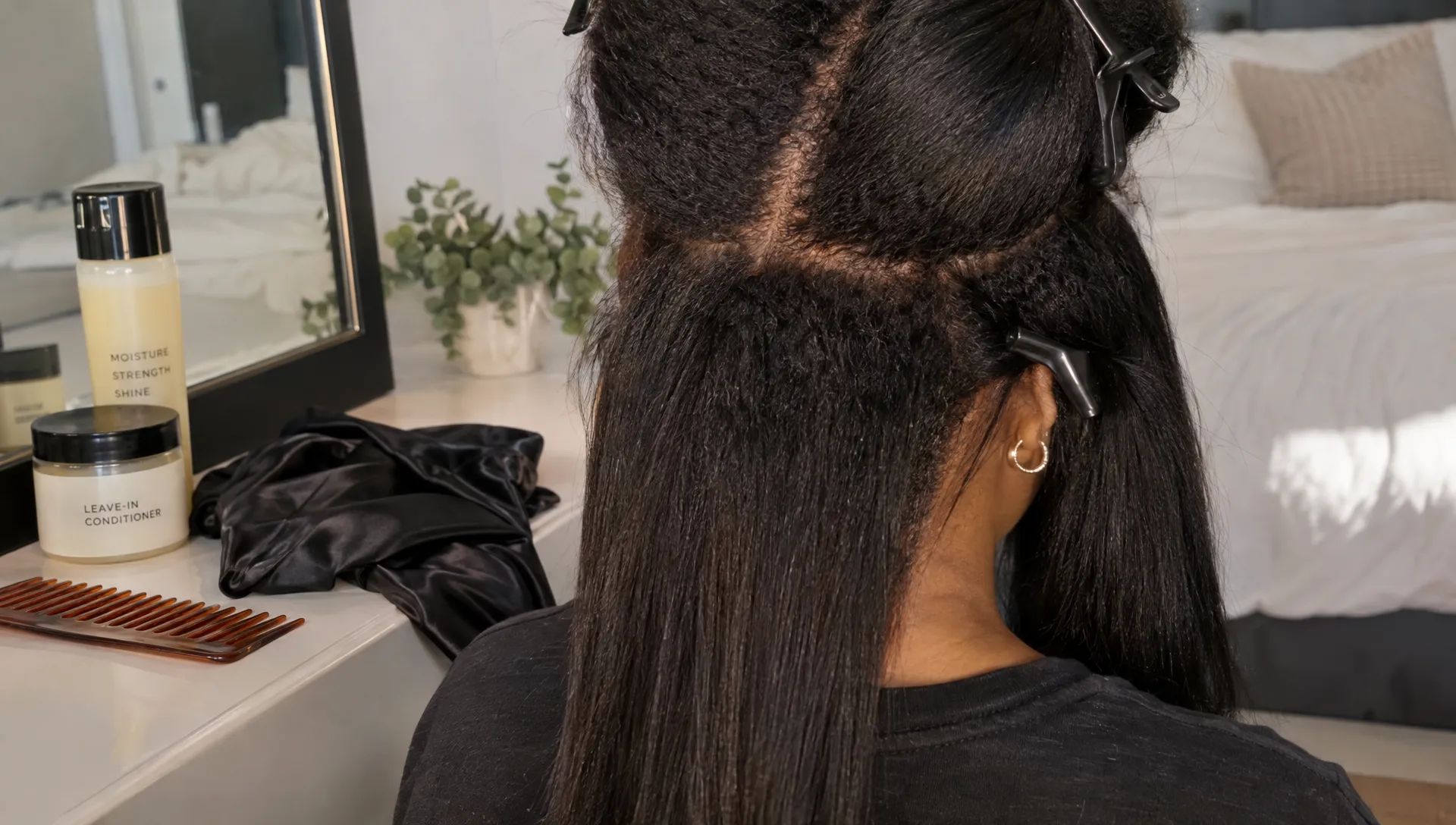
A relaxer permanently changes the treated hair. The texture growing from your scalp is new, untreated hair, not a sign that your previous service has worn off.
The meeting point between new growth and straightened lengths is often called the line of demarcation. It deserves gentle handling because tugging through a knot can place stress on hair already weakened by chemical processing.
Rather than trying to make your roots perfectly match your ends every day, focus on keeping both textures manageable. Work in sections, avoid brushing aggressively from the scalp downward and loosen any style that pulls at your hairline. More visible texture alone is not a reason to rush into another chemical service.
Give relaxed hair a consistent wash-day routine #
Cleanse your scalp and condition your lengths #
A weekly wash is a reasonable starting point for many people, but adjust it for exercise, scalp oiliness and product buildup. An itchy or coated scalp should not have to wait until your next salon appointment to be cleaned.
Apply shampoo primarily to the scalp and massage with your fingertips rather than your nails. Let the lather travel through the lengths as you rinse, gently cleansing them without scrubbing or piling the hair on top of your head. Use a clarifying shampoo when buildup calls for it, rather than automatically at every wash.
Follow with a rinse-out conditioner, paying attention to the lengths and ends. Follow the product’s directions for processing time and rinsing. If your roots are dense or tangling, separate the hair into manageable sections so conditioner reaches those areas too.
Detangle in small sections #
For relaxed hair with noticeable new growth, detangling in small, conditioned sections can reduce unnecessary pulling. Hair is vulnerable when wet, so gentle handling matters even when conditioner provides plenty of slip.
Use your fingers to separate larger tangles, then a wide-tooth comb if needed. Begin at the ends and work gradually upward, supporting the section above the knot so you are not pulling against your scalp.
If the comb stops, stop with it. Add a little water or conditioner as appropriate and loosen the knot instead of forcing the tool through. Avoid repeatedly brushing dry roots simply to make them lie flat. Once detangled, keep sections organized until you are ready to dry or style them.
Choose treatments for an actual problem #
Deep conditioner, protein treatments and bond-building products serve different purposes. You do not need to layer all of them into every wash day.
A conditioning treatment may improve softness and manageability. Some protein-containing products can temporarily reinforce damaged strands, but they do not reverse a relaxer or permanently repair split ends. More frequent or stronger treatment is not automatically better.
For relaxed hair that stays brittle, tangles excessively or breaks despite careful handling, ask your stylist to assess the cause before adding another treatment. Chemical damage, friction and an unsuitable product routine can require different responses.
Kingdom Cute’s guide to choosing treatments for dry, stressed strands explains the differences between conditioning, protein and bond-focused options. Keep your between-visit routine simple enough to tell which product is helping.
Reduce friction and tension between wash days #
Moisturize selectively, not automatically #
Check how your hair feels before applying more product. If the ends feel dry or rough, a small amount of a suitable leave-in conditioner may help. If they already feel soft but coated, another layer may make the problem harder to manage.
Apply products where they are needed rather than saturating your scalp and roots every night. Oils can add lubrication and help limit moisture loss, but they do not replace cleansing or conditioning.
If you are unsure where a leave-in fits, the guide to using a leave-in treatment without unnecessary buildup can help you distinguish wash-day use from occasional refreshes. Follow product directions and change one part of your routine at a time.
Choose styles that do not fight your roots #
Low-tension styling helps relaxed hair stay manageable without repeatedly forcing new growth straight. Depending on your length and condition, options might include a loose bun, a roller set or a gently arranged updo.
A protective style is only protective if installation, wear and removal are gentle. Tight braids, heavy extensions and slicked-back styles that hurt can still cause damage. Tenderness, bumps or pulling around the hairline are reasons to loosen or remove a style, not wait for it to settle.
When using heat, apply a heat protectant as directed and choose the lowest effective temperature. Avoid daily passes over the roots or repeatedly heating the same section. A heat protectant reduces risk; it does not make frequent high-temperature styling harmless.
Make nighttime care easy to repeat #
Before bed, gently arrange your hair in a loose wrap or another low-tension style that suits its length. A satin or silk bonnet, scarf or pillowcase can help reduce friction. Make sure an elastic edge or tightly tied scarf is not pressing on your hairline.
Do not force a wrap if it requires aggressive brushing through textured roots. A looser arrangement may be the better choice as new growth increases.
| Moment | Practical action | What to avoid |
|---|---|---|
| Wash day | Cleanse, condition and detangle in sections | Ripping through knots to finish faster |
| Between washes | Refresh only areas that need it | Adding layers over buildup |
| Styling | Use low tension and limit repeated heat | Pulling roots flat every morning |
| Bedtime | Protect hair from friction with a loose arrangement | Tight wrapping or hairline pressure |
Adjust your routine as new growth increases #
Later in your touch-up cycle, the routine that worked immediately after your appointment may need changing. Use smaller detangling sections, allow more time for wash day and choose styles that accommodate fuller roots.
If keeping a sleek look now requires daily flat-ironing or forceful brushing, change the style rather than escalating the manipulation. Stretching appointments is not helpful if the extra weeks are filled with breakage-causing habits.
There is no single touch-up interval that is right for everyone. Your stylist should consider your hair’s condition, growth, previous processing and the relaxer manufacturer’s instructions. Do not book a service solely because a calendar says it is time.
The American Academy of Dermatology’s guidance for Black hair care recommends professional relaxer application and limiting touch-ups to new growth, not previously relaxed lengths. Overlapping chemicals can increase damage to hair that has already been processed.
Know when to contact your stylist or a dermatologist #
A change in relaxed hair should guide your next step, not automatically trigger another treatment. Notice whether you are seeing more short broken pieces, worsening tangles or thinning around areas exposed to tension.
Breakage often produces shorter pieces, while shed hairs are generally full-length strands. That distinction can help describe what you are seeing, but it is not a diagnosis. Bring photos or examples to your appointment if the change is difficult to explain.
Contact your stylist before your scheduled touch-up if your hair is becoming difficult to handle without snapping. An appointment can focus on assessment and conditioning rather than another chemical service.
Persistent scalp pain, sores, sudden patchy loss or unexplained thinning warrant evaluation by a dermatologist. Seek prompt medical care for blistering, spreading redness or signs of infection. Do not apply relaxer to an irritated or injured scalp.
Frequently asked questions #
How often should I wash between touch-ups? Start with a schedule that keeps your scalp comfortable and prevents buildup. Weekly washing works for many people, but exercise, oiliness and styling products may require adjustments. Gentle cleansing and conditioning matter more than preserving a style at the expense of scalp comfort.
Should I oil my scalp every day? Not automatically. Daily oiling is not a requirement for healthy relaxed hair and may contribute to buildup for some people. If your scalp is persistently itchy, flaky or sore, seek an assessment instead of repeatedly covering the symptoms with oil.
Can I flat-iron only the new growth? Repeated root touch-ups with a flat iron still expose nearby hair to heat and can pull on the meeting point between textures. Limit heat sessions, use protection as directed and choose a style that does not require daily straightening.
Is stretching a relaxer always healthier? No. Avoiding unnecessary chemical services can reduce exposure, but extending the interval is not beneficial if it leads to severe tangling, excessive heat or rough handling. Set a plan with your stylist based on your hair’s condition rather than a stretching challenge.
Should I get a touch-up if my scalp is irritated? Tell your stylist and postpone chemical processing until the problem has been assessed and resolved. Burning, sores and persistent tenderness are not normal conditions to work around.
Plan your next visit around your hair’s condition #
At your next appointment, explain how often you wash, which products you use, how you style your roots and where you notice tangling or breakage. Those details help your stylist make useful recommendations rather than guessing from the finished style.
At Kingdom Cute in Warner Robins, GA, personalized consultations, relaxer services and scalp and conditioning treatments can support a between-visit plan. Book a consultation to discuss your current growth, hair condition and the right next step before your next touch-up.
Tags: relaxed hair