Publish on by Kingdom Cute Luxury Hair Salon
- Clear vs. tinted formulas at a glance
- When clear hair gloss is the better choice
- When a tinted formula makes more sense
- Match the finish to your hair, not just the shade name
- For blonde, highlighted or porous hair
- For brunette, curly or coily hair
- Salon or at home: which approach fits your goal?
- How long the finish lasts and how to maintain it
- Frequently asked questions
- Choose your finish with a personalized consultation
A hair gloss can add shine without changing your color, or it can refresh the tone while making the surface look more polished. The difference comes down to whether the formula is clear or tinted, plus how it works with your starting shade and hair condition.
Choose clear when you like your current color and mainly want shine. Choose tinted when you want shine plus a tonal adjustment, such as softer brassiness, richer brunette color or a warmer blonde. Neither option is a substitute for lightening, repairing significant damage or covering resistant gray with opaque color.
Clear vs. tinted formulas at a glance #
Both options can leave hair looking smoother and more reflective. Clear formulas contain no added color pigment, while tinted formulas deposit pigment to influence the shade you see.
| What matters | Clear gloss | Tinted gloss |
|---|---|---|
| Main purpose | Enhance shine without adding pigment | Enhance shine while adjusting color |
| Best starting point | A color you already like | Faded color or a tone you want to refine |
| Effect on brassiness | Does not neutralize unwanted warmth | Can soften warmth with the right formula |
| Effect on depth | Not intended to add depth | May make hair look richer or darker |
| Gray hair | Adds no gray coverage | May softly blend some gray, depending on the formula |
| Main caution | Clear does not automatically mean developer-free | Porous areas can absorb pigment unevenly |
“Gloss” is a service category, not one universal formula. Some products are direct-deposit treatments, while others use an activator. Ask what your stylist plans to use rather than assuming every product with the same label behaves identically.
When clear hair gloss is the better choice #
Clear makes sense when the sentence “I love my color, but it looks dull” describes your goal. You might have natural brunette hair, freshly colored copper or highlights whose tone still looks right.
Without added pigment, a clear treatment is not designed to cool down orange, cancel yellow or deepen a faded shade. Its role is cosmetic shine and, depending on the product, a smoother feel. A naturally warm brown will still look warm afterward.
It can also suit someone who wants to try a salon shine treatment without deliberately adding color. Still, clear does not automatically mean chemically inactive. The complete formula and any activator matter, especially on previously lightened or sensitized hair.
Think of the result as a finishing service rather than damage reversal. Split ends remain split, and breakage needs its own assessment. If your hair feels rough because of buildup, dryness or repeated heat exposure, your stylist may recommend addressing that cause before choosing a shine treatment.
When a tinted formula makes more sense #
If your blonde has turned too yellow or your brunette looks more orange than you want, shine alone will not solve the issue. A tinted hair gloss can adjust the visible tone while adding a polished finish.
The shade needs to match the problem. Violet-based formulas may help soften yellow, while blue-based formulas may help reduce orange. That does not make “ash” the right answer for everyone. Applying too much cool pigment can leave light, porous hair looking dull, grayish or muddy.
Tinted formulas are also useful for adding warmth. A beige blonde, golden brunette or copper refresh may look more flattering than an aggressively cool result. Neutralization is an option, not a rule that all warmth must disappear.
For brunettes deciding whether unwanted orange needs an in-salon adjustment or a maintenance product, our guide to when blue shampoo helps and when to skip it explains that distinction.
A tinted treatment is generally intended to deposit or refine color, not create a substantially lighter base. If you want to go from dark brown to noticeably lighter caramel, that usually requires a separate lightening plan. Adding tone cannot create the same change as removing natural pigment.
Match the finish to your hair, not just the shade name #
For blonde, highlighted or porous hair #
Lightened ends can absorb pigment differently from healthier roots. That is why a formula that looks subtle on one section may look much cooler or deeper on another.
Choosing a hair gloss for highlighted hair should account for the lightest pieces, not just the overall color. A stylist may adjust the formula, application order or timing by area. A strand test can help reveal how fragile or highly porous sections will respond.
For brunette, curly or coily hair #
Brunettes should consider whether they want to keep their existing warmth or reduce it. Clear can preserve a golden or reddish character, while tint can refine it. A cooler result may also appear darker, even when the goal was simply less brassiness.
On curls and coils, shine may appear as smaller highlights along each curve rather than one broad reflection. That does not automatically mean the treatment worked less well. Judge the result by tone, feel and definition as well as shine, preferably in your usual hairstyle.
Bring a reference photo in lighting similar to your own. A highly styled image under bright salon lights can set a different expectation from air-dried hair viewed outdoors.
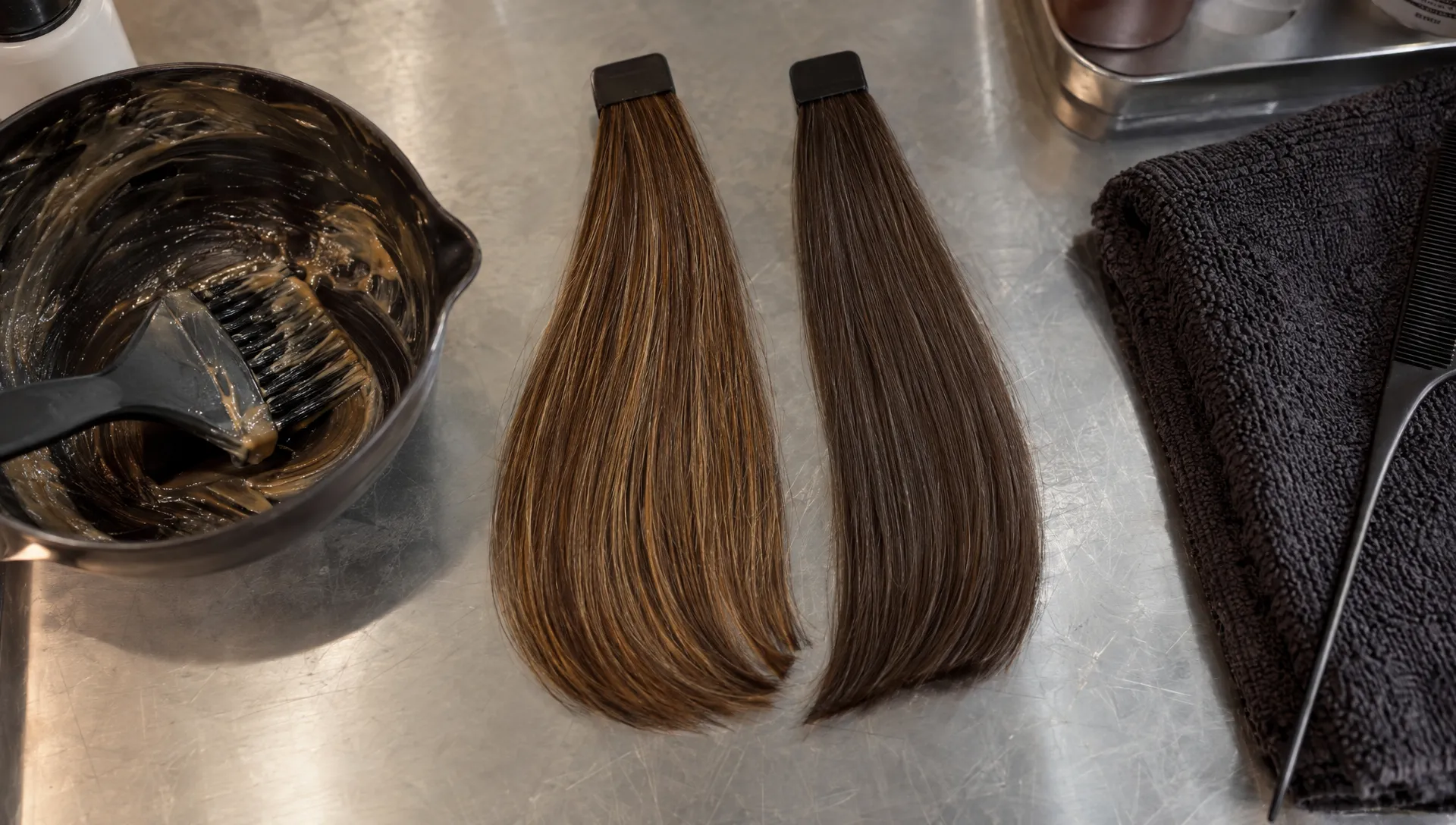
Salon or at home: which approach fits your goal? #
A salon consultation is especially useful when you have uneven color, very light highlights, previous box dye or a history of chemical services. The challenge is not simply applying product. It is predicting how different sections will respond.
Before using an at-home hair gloss, check whether it requires an activator, whether it is compatible with your hair history and whether the shade is intended for your starting color. “Universal” descriptions do not guarantee an identical outcome on every head of hair.
A strand test and an allergy test answer different questions. A strand test checks the likely color result and hair response. A skin allergy test checks for a possible reaction according to the product’s instructions. One does not replace the other.
The FDA’s hair dye safety guidance advises following package directions and performing the recommended skin test each time you use hair dye. Do not assume a tinted product is allergy-free because it is described as gentle or ammonia-free.
If your scalp is irritated or your hair is breaking, pause before applying another chemical treatment. Tell your stylist about recent coloring, bleach, relaxers, henna and other treatments so they can assess compatibility. Do not improvise processing times or mix products from unrelated systems.
How long the finish lasts and how to maintain it #
The effect is temporary, but there is no single fade schedule that applies to every formula. Expect the visible benefit to soften over the following weeks, with longevity influenced by washing frequency, porosity, heat styling and the product used.
A tinted hair gloss may fade differently across the head. Lightened ends can retain some pigments longer, while another section loses tone sooner. “Temporary” should not be interpreted as a promise that every trace will disappear evenly.
For maintenance, keep the routine practical:
- Use shampoo and conditioner suited to your hair condition and color service.
- Wash as often as your scalp needs rather than forcing an uncomfortable schedule.
- Limit unnecessary high heat and use an appropriate heat protectant when styling.
- Ask before adding a blue, purple or color-depositing product that could alter the salon result.
Book a refresh based on how the finish looks and feels, not a rigid calendar alone. If the tone still suits you but the hair feels dry, conditioning or a change in styling habits may be more useful than adding more pigment.
Frequently asked questions #
What’s the point of a hair gloss? It provides a temporary cosmetic refresh. Clear formulas focus on shine without added pigment, while tinted formulas also adjust tone or enrich color. The treatment does not permanently repair damaged hair or replace a haircut when ends are split.
Can I use it on virgin hair? Yes, some formulas are suitable for hair that has never been colored. Clear is an option if you want to preserve your natural shade, but ask whether the complete formula could affect your base. Tinted products may leave a visible color change.
How much does it usually cost? Pricing depends on the salon, formula, hair length and whether the service is booked alone or with coloring. Ask for a quote that clarifies whether consultation, shampooing and blow-drying are included. Kingdom Cute’s specific pricing should be confirmed directly.
Will clear make my color lighter? It is not designed to lighten hair. However, the formula and activator still matter, so confirm that the chosen system supports your goal of keeping the existing base unchanged.
What do salons use to make hair shiny? Results may come from a gloss, conditioning treatment, careful blow-drying or a finishing product. The right choice depends on whether dullness comes from faded color, surface roughness, buildup or styling. More shine does not always require more color.
Choose your finish with a personalized consultation #
The best hair gloss choice starts with one clear goal: preserve your current shade or change its tone. Bring a photo of the finish you like and explain which warmth, depth or highlights you want to keep.
Kingdom Cute offers personalized consultations and luxury coloring in Warner Robins, GA. Book a consultation with Kingdom Cute to discuss your hair history, the finish you want and which available service fits your needs.
Tags: hair gloss