Publish on by Kingdom Cute Luxury Hair Salon
- Scalp exfoliation vs. clarifying shampoo: the main difference
- Identify what is actually building up
- Flakes do not automatically mean you need a scrub
- Choose an exfoliant without overdoing it
- How to use clarifying shampoo safely
- How to use an exfoliating treatment safely
- Adapt the routine for your texture and salon services
- Curly, coily and densely textured hair
- Braids, extensions and other protective styles
- Color-treated, relaxed or fragile hair
- How often should you use either option?
- When to stop and see a dermatologist
- Frequently asked questions
- Choose a wash-day plan that fits your hair
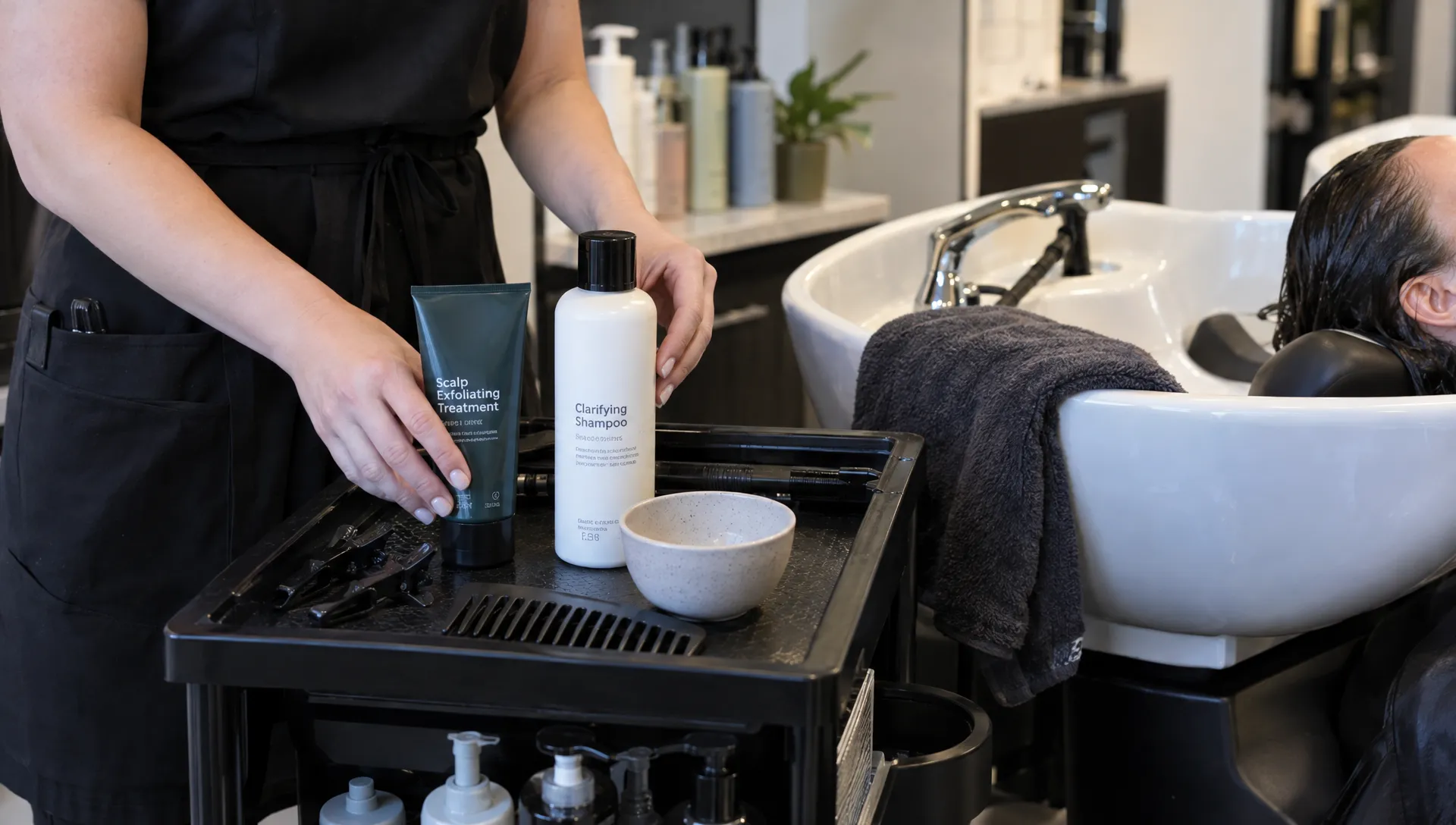
Scalp exfoliation and clarifying shampoo can both help with buildup, but they are not interchangeable. Clarifying shampoo primarily removes accumulated oils and product residue from the scalp and hair. Exfoliating treatments help loosen dead skin cells at the scalp’s surface. If styling residue remains after a normal wash, a clarifying shampoo is usually the more logical first step than a scrub.
The tricky part is recognizing what you are seeing. Dry shampoo, edge control, flaky skin and dandruff can leave similar-looking debris, yet they need different care. Using a stronger cleanser or scrubbing harder will not solve every problem. Here is how to choose the least aggressive option that addresses your buildup while protecting your texture, color and scalp comfort.
Scalp exfoliation vs. clarifying shampoo: the main difference #
Clarifying shampoo targets residue; exfoliation targets accumulated surface skin cells. There is some overlap, especially when a shampoo contains an exfoliating ingredient such as salicylic acid.
Clarifying formulas use cleansing ingredients to lift away oils and styling deposits. They work on both the scalp and hair, making them useful when strands feel coated, roots seem unusually heavy or products no longer distribute evenly.
An exfoliating product works differently. A physical formula uses particles and gentle movement to dislodge surface debris. A chemical formula uses ingredients that loosen the connections between dead skin cells, helping them shed more easily. Neither approach should require forceful rubbing.
| Main concern | More relevant starting point | Important limitation |
|---|---|---|
| Waxy residue from pomade, dry shampoo or styling products | Regular shampoo first, then a clarifying shampoo if needed | Stronger cleansing can leave dry lengths feeling rough |
| Surface dead skin on an otherwise comfortable scalp | A gentle, scalp-specific exfoliating product may help | Scrubbing cannot identify or treat the cause of recurring flakes |
| Persistent itching, redness or greasy scale | Assessment for dandruff or another scalp condition | Cosmetic cleansing alone may not resolve it |
| Suspected hard-water mineral deposits | A product specifically labeled for mineral removal or chelation | Not every clarifying shampoo removes mineral deposits effectively |
Product names are not standardized across brands. Read the directions and intended use rather than assuming that anything labeled “detox” does all four jobs.
Identify what is actually building up #
Start with your recent routine. Have you been layering edge control, refreshing dry shampoo daily or adding oils between washes? Does the coating affect your hair as well as your scalp? Those clues make product residue more plausible.
Scalp exfoliation is less likely to be necessary when the main problem is a film along the hair shaft. A scalp-only treatment cannot reliably remove deposits throughout your lengths.
Notice what happens after a thorough wash with your usual shampoo. Separate dense hair enough to reach the scalp, follow the product instructions and rinse completely. An incomplete wash can look like a need for a stronger product when application was the actual issue.
Residue that improves after cleansing supports a buildup explanation, but appearance alone is not a diagnosis. White particles may be dried styling product, skin flakes or something else. Avoid scraping at them with your nails to investigate.
Flakes do not automatically mean you need a scrub #
Dandruff and seborrheic dermatitis can cause recurrent flaking, sometimes with itching or greasy scale. Contact irritation from a hair product can also produce flaking and discomfort. These problems need a different approach from ordinary styling buildup.
Scalp exfoliation may remove visible flakes temporarily without addressing why they keep returning. Repeatedly stripping them away can make an already irritated scalp feel worse.
The Mayo Clinic’s dandruff treatment guidance describes medicated shampoos with different active ingredients, including ingredients that address yeast or help loosen scale. These are treatment choices, not simply stronger cosmetic cleansers.
If flakes return quickly, our guide to choosing a dandruff treatment for your scalp explains why identifying the likely cause matters. Persistent symptoms, especially with redness or soreness, deserve a dermatologist’s assessment rather than another exfoliating session.
Choose an exfoliant without overdoing it #
Physical scrubs and chemical exfoliants have different drawbacks. A scrub can be difficult to distribute through dense roots, and particles may remain trapped if rinsing is incomplete. Excessive pressure can also irritate skin or tangle fragile hair.
Chemical exfoliants avoid that gritty texture, but “chemical” does not mean automatically gentle. Ingredients such as salicylic acid and glycolic acid can irritate some scalps, particularly when combined with other active treatments or used more often than directed.
For scalp exfoliation, choose a product specifically formulated for the scalp rather than adapting a facial peel or body scrub. Check whether it is a rinse-out treatment, a shampoo or a leave-on formula. Those instructions are not interchangeable.
Skip homemade mixtures containing coarse salt, baking soda or lemon juice. Their abrasiveness, concentration or pH can be unsuitable for sensitive skin, and they offer no clear advantage over a properly formulated product.
There is also no need to chase a tingling sensation. Burning, stinging and tenderness are reasons to stop, not evidence that a treatment is working. People with eczema, psoriasis or an inflamed scalp should ask their clinician before adding an exfoliant.
How to use clarifying shampoo safely #
Choose a clarifying formula compatible with your hair’s condition and any salon services you have had. Then follow its instructions for application, contact time and repeat washing. Leaving it on longer does not automatically improve the result.
Wet your hair thoroughly and distribute the cleanser so it reaches the scalp. Massage gently with your fingertips, not your nails. Allow the lather to move through the lengths as you rinse rather than aggressively rubbing your hair together.
The American Academy of Dermatology’s advice on preventing hair damage recommends concentrating shampoo at the scalp instead of rubbing it throughout the hair. That distinction is useful when roots need cleansing but ends are already dry.
Rinse thoroughly and condition according to your hair’s needs, concentrating on the lengths and ends. A clarifying wash should leave you without the unwanted coating, not with a painful or persistently tight scalp.
Do not automatically follow it with scalp exfoliation. When trying either method for the first time, using one treatment on its own makes it easier to judge whether it helped or caused irritation.
How to use an exfoliating treatment safely #
Begin with a scalp that is comfortable and unbroken. Do not apply exfoliants to scratches, sores, sunburn or areas irritated by a recent chemical service.
Part your hair into manageable sections so the product reaches skin instead of sitting on top of your hair. Use only the amount directed. More product can make rinsing harder without improving the outcome.
For a physical scrub, use light fingertip pressure and keep the movement controlled. Avoid rough circular rubbing that catches and twists the roots. For a chemical formula, follow its stated contact time and wash-out instructions exactly. Do not leave a rinse-out product on overnight.
Afterward, rinse carefully around the crown, behind the ears and at the nape, where residue can remain unnoticed. Condition your hair as needed without adding a heavy layer back onto the scalp.
Judge the result over the following day or two. Reduced residue without redness or discomfort is a better outcome than a dramatic “squeaky-clean” sensation. If irritation develops, stop the new treatment and return to a gentle routine while seeking advice if symptoms persist.
Adapt the routine for your texture and salon services #
Curly, coily and densely textured hair #
Dense roots can make product application and rinsing more demanding. Working in sections helps you clean the scalp without repeatedly scrubbing or tangling the lengths.
A non-gritty treatment may be easier to rinse from tightly coiled hair than a particle-based scrub. That is a practical advantage, not a guarantee that the formula will suit your skin. Ingredient tolerance still matters.
Keep conditioning focused where your hair needs it most. If your scalp feels coated but your ends feel dry, those two areas need different care. You do not have to choose between leaving residue at the roots and aggressively cleansing every inch of your hair.
Braids, extensions and other protective styles #
Scalp exfoliation needs particular care when access to the skin is limited. Scrub particles and thick treatments can become trapped around braids, wefts or attachment points, making complete removal difficult.
Follow the care instructions for your specific extension or installation method. Not every cleanser or exfoliating formula is suitable for bonds, adhesive or other attachments. Ask your stylist before applying a new active product around them.
If you cannot rinse a treatment thoroughly, postpone it rather than leaving residue beneath the style. Persistent buildup may mean your wash method needs adjusting or the style needs to come down. Painful, tight braids require attention to the tension itself, not a stronger cleanser.
Color-treated, relaxed or fragile hair #
Frequent strong cleansing may accelerate color fading or leave processed lengths feeling drier. Look for compatibility with your service, but remember that a “color-safe” label does not make unlimited use harmless.
After a relaxer, color service or other chemical treatment, ask your stylist when an additional cleansing or exfoliating step is appropriate. Do not apply an active treatment to a scalp that remains irritated.
If your hair is already breaking, reduce unnecessary friction and avoid treating every rough feeling as buildup. A stylist can help distinguish a coated surface from damage that needs a different plan.
How often should you use either option? #
There is no universal weekly schedule. Your styling products, wash frequency, scalp condition and the formula’s directions all matter.
For occasional product buildup, a clarifying wash every two to four weeks can be a starting point if the product instructions and your hair’s condition allow it. Some people need it much less often. If your regular shampoo removes residue effectively, there is no reason to add a stronger wash just because the calendar says so.
Scalp exfoliation should also be need-based rather than automatic. Start conservatively within the product’s directions and do not increase frequency when your scalp is uncomfortable. If you use a medicated shampoo or another active scalp treatment, ask a dermatologist or pharmacist before adding an exfoliant.
Change one part of your routine at a time. When you introduce several “deep-cleaning” products together, it becomes difficult to tell which one helped and which one caused dryness or irritation.
When to stop and see a dermatologist #
Stop the new product if it causes burning, worsening itch, redness or tenderness. Rinse it out if it is still on your scalp. Do not try to correct irritation with another scrub, acid treatment or stronger shampoo.
Scalp exfoliation is not an appropriate response to open sores, bleeding or unexplained hair loss. Seek medical advice for:
- Persistent flaking or itching despite appropriate care.
- Crusting, drainage, pus or painful bumps.
- Patchy hair loss, spreading redness or significant tenderness.
- Symptoms that repeatedly return after the apparent buildup is removed.
Seek prompt care for severe or rapidly worsening symptoms. A salon consultation can help with product selection, application and styling habits, but it does not replace diagnosis or treatment of a scalp disease. Bring the names of the products you use so your clinician can review possible irritants and overlapping ingredients.
Frequently asked questions #
Can I use an exfoliating treatment and clarifying shampoo on the same day? Some products are designed to work together, but do not assume yours are. For a new routine, try one method at a time. Follow the labels and avoid combining several exfoliating or deep-cleansing products, especially on a sensitive scalp.
Does scalp exfoliation help hair grow? It can help remove surface debris, but that is not the same as stimulating hair growth. It is not an established treatment for pattern hair loss. Persistent thinning or unusual shedding needs an assessment rather than more intensive scrubbing.
What is the best option for thinning hair? There is no single best scrub for thinning hair. Use gentle cleansing that suits your scalp and minimize friction. If thinning is new, worsening or accompanied by inflammation, ask a dermatologist about the cause before adding a treatment.
Will clarifying shampoo remove hard-water buildup? Not necessarily. Mineral deposits may need a product specifically labeled for chelation or hard-water removal. Check the intended use instead of assuming “clarifying” and “chelating” mean the same thing.
Should my scalp feel squeaky clean afterward? No. The goal is to remove unwanted residue without causing tightness, stinging or tenderness. Those uncomfortable sensations suggest the product, technique or frequency may not suit you.
Choose a wash-day plan that fits your hair #
If you are unsure whether you need a clarifying wash, a gentler routine or professional scalp care, start with a consultation. Bring your product list and explain when the coating or flakes appear.
At Kingdom Cute in Warner Robins, GA, personalized consultations can help connect your cleansing routine with your texture and salon services. Explore our hair treatment services for scalp and strands to discuss suitable care without adding unnecessary steps to wash day.
Tags: scalp exfoliation