Publish on by Kingdom Cute Luxury Hair Salon
- First, separate breakage from shedding
- Match hair breakage treatment to the pattern
- Heat damage: examine the whole styling routine
- Chemical damage: look for overlap, not just dryness
- Friction and tension: inspect the small daily habits
- Start with a short damage-reduction reset
- Choose products for the problem you actually have
- Track less snapping, not just softer hair
- Know when a salon visit is not enough
- Frequently asked questions
- Bring the pattern to your consultation
Finding short pieces of hair on your shoulders can make a stronger conditioner feel urgent. But effective hair breakage treatment starts with a different question: what is making the strands snap? Repeated flat-ironing, overlapping chemical services and everyday friction need different fixes. A treatment may make hair feel smoother, but it cannot compensate for damage that keeps happening.
Before buying another mask or scheduling a corrective service, look at what is breaking, where it happens and what changed before it started.
First, separate breakage from shedding #
Breakage happens along the hair shaft. Shedding releases a strand from its follicle. They can happen together, but they are not interchangeable.
Broken hair often appears as pieces of different lengths, uneven ends or sections that struggle to retain length. Shed hairs are usually closer to your full hair length and may have a small pale club at one end. That club is not the entire follicle. Its absence alone also does not prove a strand broke.
Short hairs around your forehead need context, too. They may be new growth rather than damage. Look for a combination of clues, such as frayed ends, a history of tight styling or snapping during detangling, instead of judging by length alone.
If your part is widening or your scalp is becoming more visible, do not assume the problem is simply brittle ends.
Match hair breakage treatment to the pattern #
Where strands break can help narrow down the likely cause. These patterns are clues for a consultation, not a diagnosis.
| What you notice | Possible contributor | What to check first |
|---|---|---|
| Short pieces concentrated around the hairline | Tension, edge styling or repeated brushing | Tight ponytails, braids, extensions and edge-tool use |
| Breakage concentrated in lightened sections | Chemical processing damage | Bleach history and overlapping applications |
| Rough, splitting ends with frequent tangles | Weathering and friction | Detangling habits, heat exposure and delayed trims |
| Short pieces where a ponytail elastic sits | Repeated mechanical stress | Elastic type, tightness and daily placement |
| Breakage after frequent silk presses or flat-ironing | Cumulative heat damage | Temperature, number of passes and touch-ups |
| Fragile hair with patchy loss or scalp symptoms | A possible scalp or medical condition | Dermatology evaluation rather than another cosmetic treatment |
Timing matters as much as location. Think back to the weeks before the change: a color correction, new extensions, more frequent heat styling or a different detangling routine may offer a useful lead.
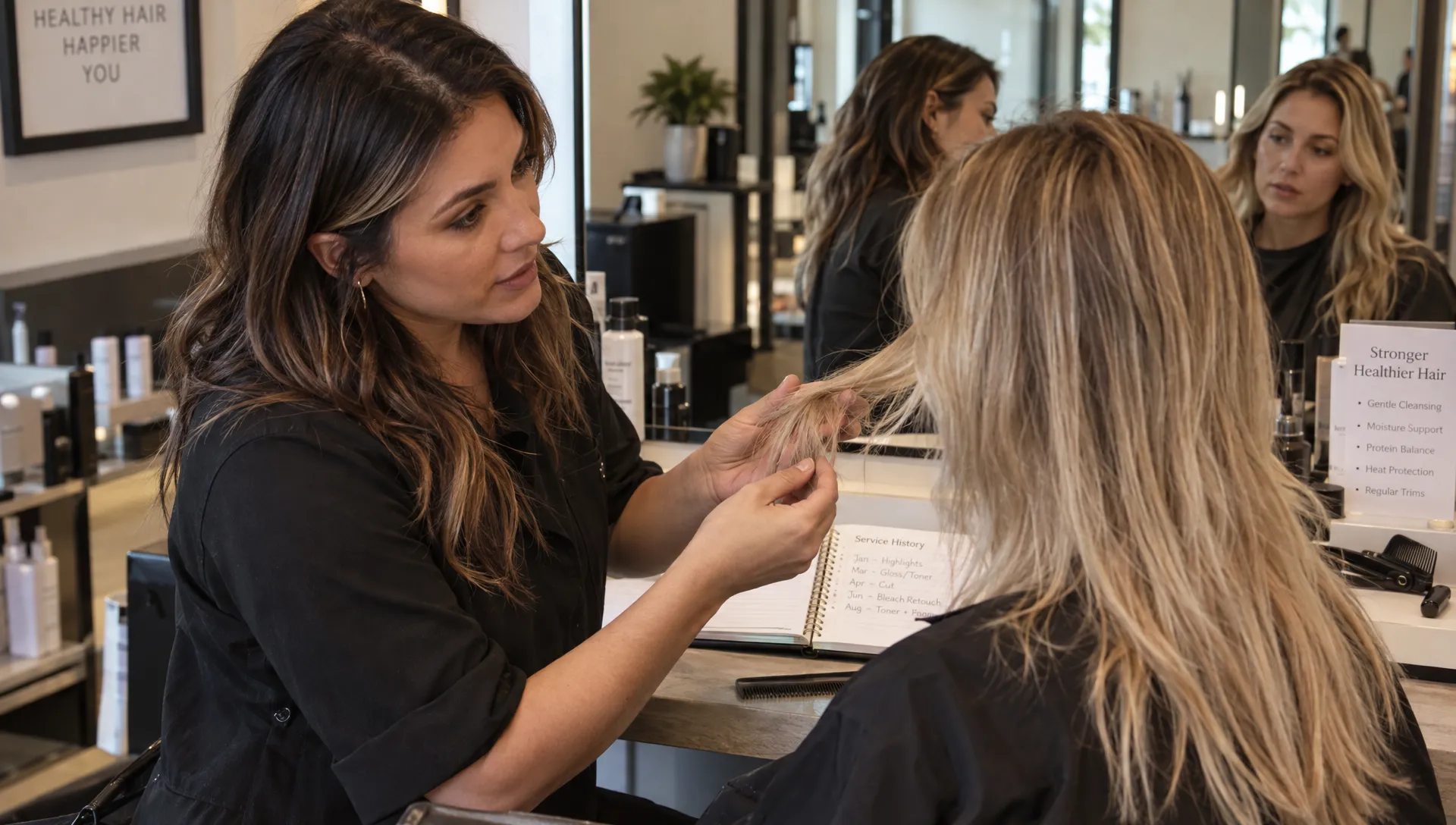
Bring that history to your appointment. Choosing hair breakage treatment becomes more practical when your stylist can connect the weak areas with specific services and habits.
Heat damage: examine the whole styling routine #
Heat exposure adds up across blow-drying, flat-ironing, curling and between-wash touch-ups. A heat protectant is useful, but it does not make unlimited passes or very high temperatures harmless.
The American Academy of Dermatology’s guidance on preventing hair damage recommends limiting hot-tool use and using lower heat settings. There is no single ideal temperature for every head of hair, especially when strands have also been lightened or chemically straightened.
If breakage follows repeated silk presses, discuss fewer touch-ups and a temporary lower-heat styling plan. Avoid using a flat iron on damp hair unless the tool is specifically designed for that use. A mask should not be used as permission to continue the same damaging routine.
Chemical damage: look for overlap, not just dryness #
Bleach, permanent color, relaxers and other chemical services can weaken hair, particularly when previously processed lengths are treated again. Breakage concentrated in certain bands or highlighted sections deserves a close look at your service history.
Tell your stylist about at-home color, relaxers and smoothing services, even if they happened months ago. Previously treated hair remains on your head as it grows out.
For chemically weakened lengths, hair breakage treatment should begin with preventing further incompatible or overlapping processing. Conditioning or bond-building products may improve manageability and reduce some signs of damage, but they cannot make severely compromised hair equivalent to untouched hair. Another chemical service may need to wait, change or be avoided on fragile areas.
Friction and tension: inspect the small daily habits #
Breakage does not always follow a dramatic salon service. Pulling through tangles, sleeping with the same tight ponytail or repeatedly brushing edges can stress the same strands every day.
Detangling technique should suit your texture. Straight hair often benefits from less handling while wet. Tightly curled or coily hair is commonly easier to detangle in sections while damp and lubricated with conditioner. Start at the ends, support the section above the knot and work upward without forcing the tool through resistance.
Protective styles still need to be comfortable. Pain, stinging or visible pulling at the hairline are reasons to loosen or remove a style, not signs that it will last longer. Persistent tension can affect follicles as well as break the shaft.
Start with a short damage-reduction reset #
The first goal is to stop adding avoidable stress while you work out the cause. Keep the routine simple enough that you can tell what helps.
A useful hair breakage treatment plan often begins with these changes:
- Pause optional chemical processing: Give your stylist the full service history before booking another color, relaxer or smoothing appointment.
- Reduce repeated heat exposure: Skip unnecessary touch-ups and choose styles that do not require daily hot tools.
- Improve slip during detangling: Use a suitable conditioner and work through small sections without pulling.
- Remove repeated tension: Loosen tight styles and avoid fastening hair in exactly the same place every day.
Continue cleansing your scalp as needed rather than stretching wash days indefinitely to avoid touching your hair. Buildup and tangling can make the next wash harder to manage.
This reset is a way to reduce ongoing damage, not a promise that broken lengths will recover in two weeks. If hair keeps snapping during gentle handling, arrange an assessment instead of adding more products.
Choose products for the problem you actually have #
Dryness and structural damage can overlap, but they are not the same thing. Dry-feeling hair may improve noticeably with conditioning. Chemically weakened hair may feel softer afterward while remaining vulnerable to snapping.
A rinse-out conditioner can improve slip and reduce friction during grooming. A deep conditioner may help rough, difficult-to-manage lengths. Neither permanently seals split ends, and a trim may be the most practical way to remove ends that keep catching and tangling.
Protein-containing and bond-building formulas are not interchangeable, and product claims vary. Avoid assuming every brittle strand needs more protein or using an at-home stretch test as a definitive diagnosis. Follow the product directions rather than layering several intensive treatments at once.
The best product for hair breakage treatment is one that supports the cause-specific changes you are making, not simply the bottle labeled “repair.” Shampoo mainly cleanses; it is unlikely to solve repeated chemical overlap or tension by itself.
For help building a manageable routine, our guide to choosing professional hair care products explains how cleansing, conditioning and styling products serve different roles. Your stylist can help narrow those choices to your texture and processing history.
Track less snapping, not just softer hair #
Softness is useful, but it is not the only sign of progress. Hair can feel coated and smooth while still breaking during styling.
Take a few photos of the affected areas under similar lighting, with the same part and a comparable style. Record when snapping happens: during shampooing, detangling, heat styling or removal of a protective style. Note any changes to tools, products or salon services.
Avoid comparing the amount of hair from one wash with another if the time between washes differs. More accumulated shed hair after a longer interval does not automatically mean the problem has worsened.
Judge hair breakage treatment by whether handling becomes easier and fewer strands snap under comparable conditions. Length retention takes longer to assess because existing damage does not disappear when new growth starts.
You do not need to collect or count every strand. A brief record of repeatable patterns gives your stylist more useful information than daily inspection that leaves you guessing.
Know when a salon visit is not enough #
A stylist can assess visible shaft damage, adjust services and recommend gentler care. A salon cannot diagnose medical hair loss, nutritional deficiencies or scalp disease.
Arrange a dermatologist appointment for sudden or patchy loss, a widening part, persistent scalp itching, scaling or tenderness. Broken hairs close to the scalp alongside inflamed or scaly patches also deserve medical attention. Seek prompt care for painful swelling or drainage.
Stress can affect hair, but it commonly causes increased shedding rather than directly snapping the shaft. Cleveland Clinic explains telogen effluvium as a shedding condition that can follow physical or emotional stress, often with a delay. Stress-related pulling or changes in grooming habits can separately contribute to breakage.
When density changes or scalp symptoms are present, hair breakage treatment should not delay medical evaluation. Our guide to when hair loss needs more than a salon visit explains the different roles of stylists, trichologists and dermatologists. Avoid starting supplements unless a clinician identifies a reason for them.
Frequently asked questions #
What is the best thing to stop hair breakage? Remove the ongoing source of damage first. That may mean reducing heat, stopping chemical overlap, loosening styles or changing detangling technique. Conditioner can reduce friction, but no single product addresses every cause.
Can broken hair be repaired without cutting it? Products can improve feel, manageability and resistance to further damage, but they cannot permanently rejoin a snapped strand or restore split ends to their original structure. Targeted trims can remove ends that repeatedly snag without requiring an unnecessarily dramatic cut.
How long does hair breakage treatment take to work? Better slip or softness may be noticeable after conditioning. Reduced snapping depends on the cause and how consistently further damage is avoided. Visible length retention takes longer, so judge early progress by easier handling rather than expecting rapid growth.
Should I stop coloring my hair if it is breaking? Pause additional processing until your stylist assesses the affected areas and reviews your service history. The safest next step may involve changing the technique, avoiding fragile lengths or postponing the service rather than simply adding a treatment afterward.
Bring the pattern to your consultation #
At Kingdom Cute in Warner Robins, GA, personalized consultations help connect your hair goals with your current condition and styling routine. Bring photos, your recent chemical-service history and a description of when you notice snapping.
Book a consultation with Kingdom Cute to discuss conditioning care, haircut options and styling changes suited to your hair. Start with the cause so your next service supports better length retention, not just a smoother finish.
Tags: hair breakage treatment