Publish on by Kingdom Cute Luxury Hair Salon
- Why split ends cannot heal themselves
- What a split end treatment can actually do
- When you need a trim and when you can wait
- Salon trim, home trim or split-end trimmer?
- A salon trim offers control over the overall shape
- Home trimming has limits
- Trimmer devices cannot assess your haircut
- Match your plan to your texture and styling habits
- Fine or easily weighed-down hair
- Curly and coily hair
- Bleached, relaxed or frequently heat-styled hair
- Protect the ends after they have been trimmed
- Frequently asked questions
- Plan a trim that respects your length goals
No, a split end treatment cannot replace a trim once a strand has physically split. It can smooth rough ends, reduce friction and make damage less noticeable, sometimes buying you time before an appointment. But a product cannot permanently turn a divided hair fiber back into an intact one.
That does not make treatments pointless. The useful distinction is between removing existing damage and protecting the length you still have. Understanding both helps you avoid unnecessary cutting without spending months trying to condition away a problem that needs scissors.
Why split ends cannot heal themselves #
A hair strand has an outer protective layer called the cuticle. Heat, chemical processing, rough detangling and repeated friction can wear that protection down. As damage progresses, the fiber may separate into two branches, several smaller branches or a split farther up the shaft.
Unlike skin, the visible hair shaft is not living tissue and cannot heal itself biologically. Products can change its feel and behavior, but that is different from restoring the original structure of an undamaged strand.
A split end treatment can make the damaged area feel surprisingly smooth, which explains why touch alone is not a reliable repair test. A glossy finish may be covering a split rather than eliminating it.
Look at several ends in good lighting instead. Forked tips, feathered ends and visible branches suggest splitting. Roughness or tangling alone does not prove that you need a substantial haircut, since dryness, buildup and other surface damage can also affect how hair feels.
Split fibers can deteriorate further with continued wear, although there is no fixed timetable. The practical goal is to remove visible damage before repeated snapping costs you more length than a controlled trim would.
What a split end treatment can actually do #
Most products marketed for damaged ends work by improving lubrication, coating the strand or temporarily helping separated fibers lie together. Their benefits depend on the formula and the condition of your hair.
| Product category | What it may help with | What it cannot promise |
|---|---|---|
| Conditioner or mask | Softer hair, easier detangling and less friction | Permanent removal of a split |
| Leave-in cream or serum | Smoother ends and temporary control of fraying | An intact fiber beneath every smooth-looking tip |
| Oil | Lubrication and improved feel, depending on the oil and hair | Permanent fusion of separated branches |
| Bond-support product | Some forms of chemical or structural damage, depending on its chemistry | Reversal of every type of damage or replacement of cutting |
Judge a split end treatment by manageability and reduced wear, not by whether your ends look freshly cut immediately afterward. Cosmetic smoothing is valuable, particularly when it makes detangling gentler, but its effects can diminish with washing and normal handling.
Likewise, a protein treatment, deep conditioner or bond builder is not automatically the right answer simply because the label says “repair.” These categories serve different purposes. More product is not necessarily better, and none removes an already separated tip.
When you need a trim and when you can wait #
Visible splitting across many ends, repeated snagging and ends that snap during gentle detangling are good reasons to arrange a trim. If the perimeter has become noticeably sparse or uneven from breakage, cutting may also help create a more manageable shape.
Ask your stylist to show you where the damage begins before agreeing on how much to remove. A small amount of cutting may address isolated tips, while splits higher along the shaft can require a different plan. There is no universal half-inch rule that fits every head of hair.
For an upcoming event, a split end treatment may temporarily improve the finish if the damage is limited and the hair can be handled gently. Treat that as a short-term styling choice, not proof that the split has disappeared.
Waiting is less useful when you must repeatedly brush through tangles or flat-iron rough ends to make them behave. That extra handling can add to the problem you are trying to hide.
A trim does not make hair grow faster at the scalp. Its value is removing compromised ends and helping you retain a more consistent shape. The right amount should reflect visible damage, your haircut and your length goals rather than an automatic schedule.
Salon trim, home trim or split-end trimmer? #
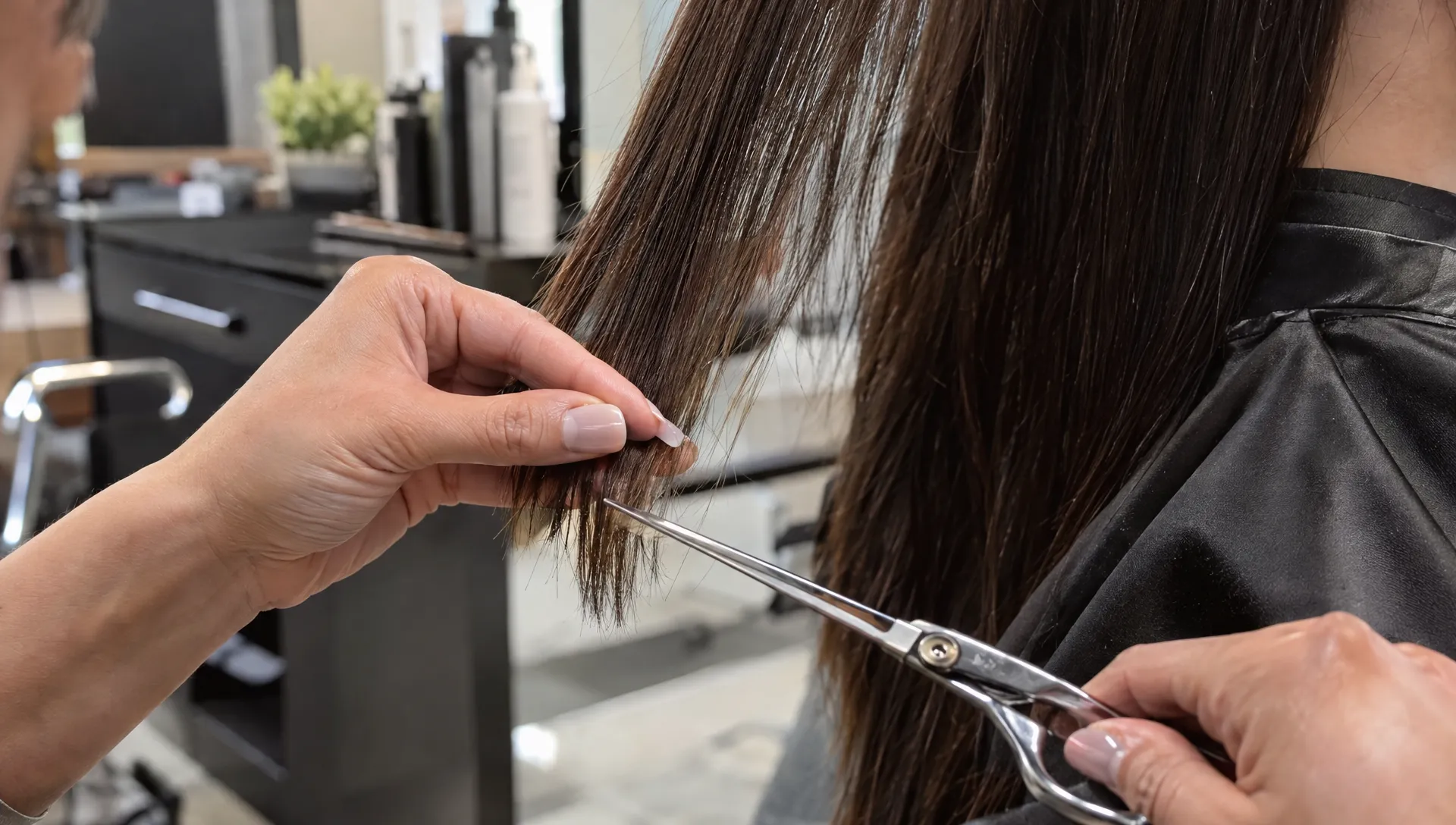
A salon trim offers control over the overall shape #
A stylist can assess the ends across different sections, account for layers and discuss how much length you want to preserve. This is especially helpful when damage is uneven or your hair has significant curl shrinkage.
“Dusting” generally describes removing a very small amount from the tips, but the term does not guarantee that every split will be removed. If damage extends beyond that small amount, ask what will remain afterward.
Home trimming has limits #
For an isolated split on an easily visible strand, a careful snip with sharp hair-cutting shears can remove that damaged portion. Household or craft scissors may crush or fray the fiber rather than make a clean cut.
Good lighting and visibility matter. Do not pull split branches apart, burn them off or aggressively twist and cut every protruding hair. Some protruding strands are shorter growth, not damaged ends.
Trimmer devices cannot assess your haircut #
A split-end trimmer may cut protruding fibers, but it cannot reliably distinguish every split from healthy shorter hair or judge the shape you want. Results depend on the device, technique and hair texture.
Neither a device nor a split end treatment replaces an assessment when breakage is widespread. If damage appears well above the ends, investigate the cause rather than repeatedly trimming the perimeter. Kingdom Cute’s guide to finding the cause of hair breakage explains that distinction in more detail.
Match your plan to your texture and styling habits #
Fine or easily weighed-down hair #
Start with a small amount of lightweight conditioner or leave-in product, concentrating on the ends. Heavy layering can make fine hair look flat without solving splitting. Increase the amount only if it improves detangling and softness without leaving an unwanted coating.
Curly and coily hair #
Detangle in sections with enough slip to avoid forcing through knots. Work from the ends upward and minimize repeated manipulation of fragile areas.
Discuss whether your stylist will assess your hair in its natural pattern, stretched or both. Shrinkage and curl shape affect how a trim looks, so agreement about the desired finished length matters as much as the amount being cut.
Bleached, relaxed or frequently heat-styled hair #
For chemically processed lengths, a split end treatment is most useful alongside changes that reduce ongoing stress. Smoothing the tips will not offset repeated chemical overlap or excessive heat.
Tell your stylist about previous color, relaxers and smoothing services before another chemical appointment. With silk presses or other heat styling, use heat protection as directed and avoid repeated passes over ends that already look frayed.
Extensions and protective styles also need attention. A style is not protective if installation, removal or daily friction is breaking the hair underneath.
Protect the ends after they have been trimmed #
The best follow-up plan reduces the wear that caused the splitting. The American Academy of Dermatology’s guidance on preventing hair damage recommends conditioning after shampooing, gentle handling and limiting damaging heat and styling practices.
Keep the routine practical:
- Condition consistently: Choose a formula that helps you detangle without excessive pulling.
- Reduce friction: Blot rather than vigorously rub with a towel, and avoid repeatedly dragging rough accessories across your ends.
- Adjust heat habits: Use the lowest effective setting and reduce unnecessary hot-tool passes.
- Review recurring damage: Notice whether the same sections split after a particular style, service or detangling habit.
Use a split end treatment as one part of that routine, not permission to keep stressing fragile hair. Follow the label rather than repeatedly applying more because the ends still feel rough.
Check progress under similar conditions, such as after washing and before heavy styling products. Notice whether you have fewer tangles and broken pieces as well as a smoother appearance. Persistent breakage despite gentler care deserves a closer assessment, not simply another layer of serum.
Frequently asked questions #
Can I repair split ends without cutting my hair? You can temporarily smooth or bind some damaged fibers and reduce further wear. However, removing the split portion with a clean cut is the reliable way to eliminate an existing split. You may not need a major haircut if the damage is limited.
How long can I postpone a trim? There is no guaranteed safe waiting period. Base the decision on visible splits, tangling, breakage and how much manipulation your hair needs. If the ends keep catching and snapping, waiting may work against your length goals.
How often should I apply products for damaged ends? Follow the product directions and adjust for buildup, weight and manageability. Applying a split end treatment more frequently does not turn temporary smoothing into permanent repair. If your ends remain difficult to handle, reassess the damage and your routine.
Does sudden breakage mean I need more conditioning? Not necessarily. Rapid changes, patchy thinning, scalp pain, sores or unusual shedding deserve evaluation by a dermatologist. A stylist can help identify visible strand damage, but salon care should not substitute for medical assessment when those symptoms are present.
Plan a trim that respects your length goals #
You should not have to choose between keeping every damaged inch and cutting more than you wanted. Start with a consultation about where the splits are, what your styling routine involves and how much length you are comfortable removing.
At Kingdom Cute in Warner Robins, GA, personalized consultations, precision haircuts and conditioning treatments can support that conversation. Book an appointment with Kingdom Cute to discuss a trim and care plan suited to your hair, rather than relying on a smooth finish to tell the whole story.
Tags: split end treatment