Publish on by Kingdom Cute Luxury Hair Salon
- Start With Your Nonnegotiables, Not More Photos
- Sort Your Pixie Haircut Gallery Into Three Useful Groups
- Overall Shapes
- Details You Want to Borrow
- Details You Do Not Want
- Check What Each Photo Actually Shows
- Compare Texture and Density Separately
- Find More Than One Angle
- Add Notes That Explain Your Choices
- Give Each Favorite an Everyday Styling Check
- Reduce the Collection to a Small Shortlist
- Turn the Shortlist Into a Consultation Brief
- Frequently Asked Questions
- Bring Your References to Kingdom Cute
A useful pixie haircut gallery does more than collect beautiful photos. It helps you identify the lengths, shapes and styling details you actually want, then explain those choices to your stylist. Without that structure, a folder of inspiration can leave you torn between cuts that have very little in common.
The goal is not to find one perfect picture to copy. It is to build a small, well-labeled collection that connects your preferences with your hair texture, daily routine and comfort level. Here is how to turn saved images into a clearer haircut decision.
Start With Your Nonnegotiables, Not More Photos #
Before saving another image, write down what you need from your haircut. This gives you a filter for deciding which references belong in your collection.
Consider how much forehead and ear exposure feels comfortable, whether you want enough length to change your part and how much time you realistically spend styling. Include anything you want to avoid, such as a closely clipped neckline or fringe that falls into your eyes.
Keep preferences separate from assumptions. “I want softness around my ears” is useful information. “My face shape means I cannot have short hair” is a conclusion worth discussing rather than treating as a rule.
Choose three priorities you can explain in plain language. For example: a longer fringe, a neat neckline and a shape that works with your natural wave. Those priorities will help you recognize relevant photos, even when the model looks nothing like you.
Sort Your Pixie Haircut Gallery Into Three Useful Groups #
Instead of saving everything to one folder, divide your references by the role they play in your decision. A phone album, Pinterest board or simple document can all work.
Overall Shapes #
Save a few photos that show the general silhouette you like. Look for how much length sits on top, how closely the sides follow the head and whether the outline looks rounded, angular or softly grown out.
If you need a starting point, these pixie cut ideas to bring to a salon visit can help you put names to different shapes. Use the names to organize your references, not as a substitute for showing pictures.
Details You Want to Borrow #
Some photos earn a place because of one feature: the fringe, sideburns, crown texture or neckline. Label that feature immediately so you do not later mistake the image for an endorsement of the whole haircut.
A note such as “love the soft edges, not the short top” gives your stylist more direction than a heart emoji.
Details You Do Not Want #
A pixie haircut gallery becomes more useful when it includes a few clearly labeled dislikes. A photo showing too much scalp at the sides or a fringe that feels too heavy can clarify your boundaries.
Keep these examples limited and specific. Explain what you would change rather than simply marking the entire style “bad.”
Check What Each Photo Actually Shows #
An attractive photograph does not necessarily provide enough information to plan a haircut. Before keeping it, check whether you can see the structure beneath the styling.
Compare Texture and Density Separately #
Texture describes whether hair is straight, wavy, curly or coily. Density describes how much hair grows across the scalp. Fine individual strands can still be densely packed, so “fine” and “thin” are not interchangeable.
Look for references that resemble both your natural texture and your overall density. A heavily styled, straightened image may still be useful, but label it as a styled finish rather than an everyday expectation.
For curly or coily hair, note whether the reference shows the hair in its natural pattern, stretched or straightened. Length and silhouette can look very different across those states.
Find More Than One Angle #
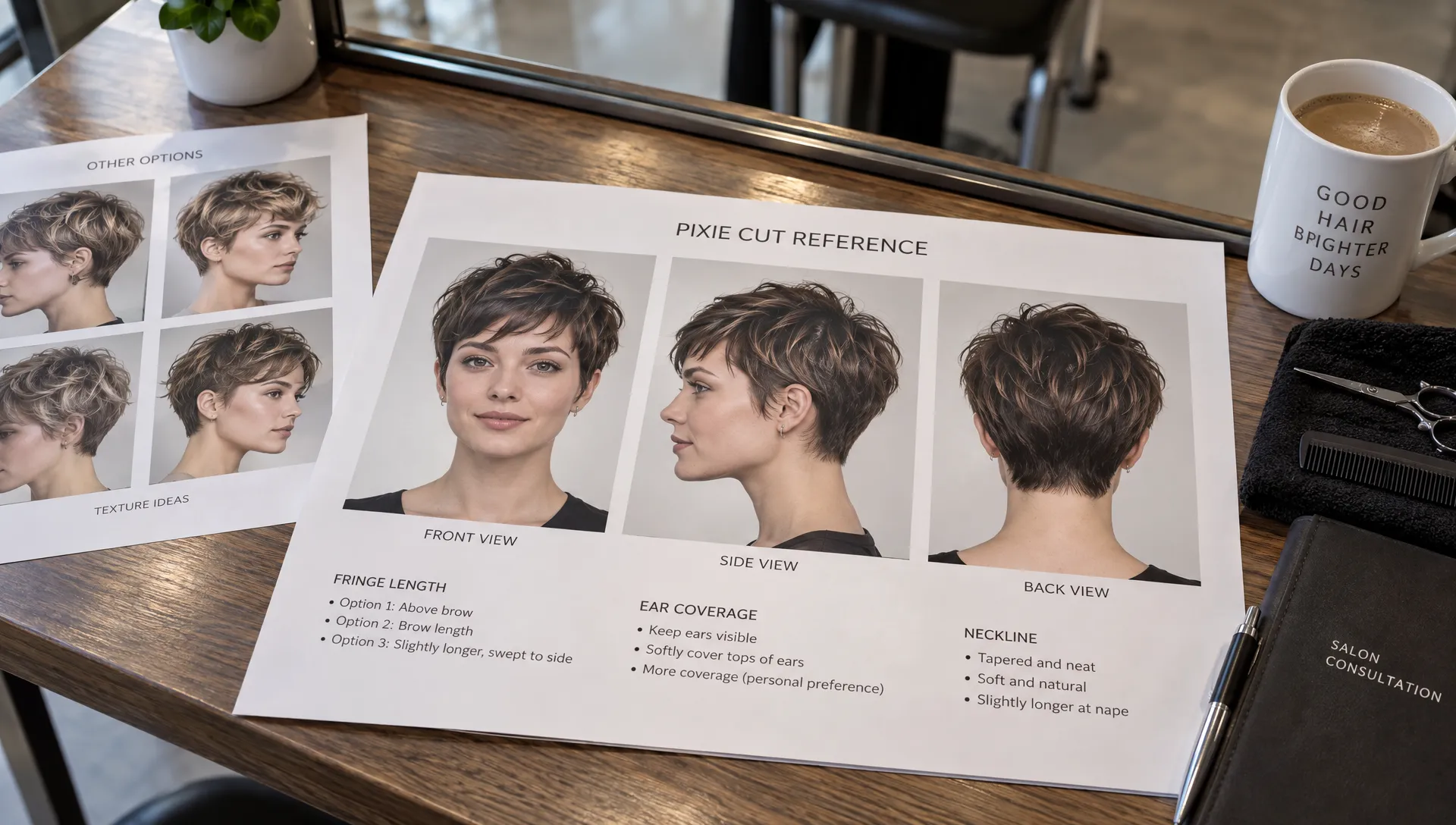
A front view helps you evaluate fringe and face framing. A side view shows the relationship between the top, temples and ears. A back view reveals the neckline and how the cut follows the head.
When reviewing your pixie haircut gallery, flag single-angle images as incomplete references. You can borrow a visible detail without assuming the hidden sections look a particular way.
Also notice head position. A tilted chin, tucked hair or a hand lifting the crown can change the apparent shape. Filters, extensions or wigs may be present without being disclosed, so treat a photograph as inspiration rather than proof of an achievable result.
Add Notes That Explain Your Choices #
The most valuable part of a reference collection is often the sentence beneath each photo. Describe what caught your attention and what you would adapt.
Use concrete observations rather than vague labels such as “edgy” or “feminine.” Those words can mean different things to different people. “Short around the ears with a longer, side-swept fringe” is much easier to discuss.
| What to record | Useful example | Why it helps |
|---|---|---|
| Main attraction | Soft fringe that sits near the brows | Identifies the feature you want to keep |
| Preferred adjustment | More coverage around the ears | Prevents an unwanted detail from being copied |
| Texture shown | Waves styled with separation | Distinguishes the cut from its finish |
| Missing information | No clear back view | Flags what still needs discussion |
| Everyday expectation | Comfortable using a dryer, not a flat iron | Connects the reference to your routine |
Avoid requesting exact measurements from a photograph. Perspective and head size make those estimates unreliable. Point to where you want the hair to sit, then let your stylist translate that preference into an appropriate length.
Give Each Favorite an Everyday Styling Check #
A photo may show a fresh salon finish rather than what the haircut looks like after sleeping, exercising or letting it dry naturally. Ask what creates the result: the cut itself, heat styling, product, a particular part or some combination.
For every finalist in your pixie haircut gallery, write down the styling effort you are willing to make. Be honest about whether you will reshape the fringe each morning, use a diffuser or apply product to separate the top.
Your getting-ready setup matters too. A clear mirror and even lighting make it easier to check the sides and neckline. If you are refreshing that space, the furniture and lighting collections at Manor Editions can provide ideas for furnishing a dressing area. Keep decorative choices separate from the practical need to see your hair clearly while styling.
Discuss upkeep before committing. There is no universal trim schedule for every pixie: a tightly defined outline may need attention sooner than a softer, longer shape. Ask your stylist what changes you are likely to notice first and how the cut could look as it grows.
Reduce the Collection to a Small Shortlist #
Once you have compared shape, texture and upkeep, choose a manageable set of finalists. Three overall looks plus a few detail references is a practical starting point, not a salon requirement.
Remove duplicates that communicate the same preference. Ten nearly identical fringe photos rarely add more clarity than two well-chosen examples.
A simple selection method is to assess each favorite against your original priorities:
- Shape: Does it have the balance of top length, side coverage and neckline you want?
- Hair match: Is the visible texture and density relevant, or does it need substantial adaptation?
- Routine: Are you comfortable with the styling and maintenance it may involve?
- Confidence: Do you like the haircut itself, or mainly the model’s color, makeup and photography?
Your pixie haircut gallery does not need a single winner before the appointment. Two strong options with clear notes can support a better discussion than one photo you feel obligated to reproduce exactly.
Turn the Shortlist Into a Consultation Brief #
Put your strongest overall reference first, followed by alternate views and detail images. Keep everything accessible on your phone or bring printed copies. Download key photos so a weak connection does not interrupt the conversation.
Prepare a short explanation: “I like this overall shape, this softer fringe and this amount of coverage around the ears. I do not want the closely clipped sides.” That statement gives the stylist both a direction and boundaries.
Then ask how your hairline, crown growth patterns, texture and density might change the result. A cowlick may affect where fringe sits, while natural curl can alter the apparent length. These are reasons to adapt a reference, not automatically reject it.
If you are still selecting a stylist, this guide to choosing the right salon for a pixie cut explains what to look for in short-hair experience and consultation quality.
Before cutting begins, confirm the planned fringe length, ear coverage and neckline together. Leave room for professional judgment, but make sure you understand any proposed departure from your references.
Frequently Asked Questions #
How many photos should I bring? Bring enough to explain the overall shape and important details without overwhelming the discussion. Three main looks and a few labeled detail images are a useful starting point.
Can I use photos of people with different hair textures? Yes, but identify what you like and ask how it would translate. A silhouette may be adaptable even when the photographed finish would require a different styling routine.
Should every reference show the same hair color? No. Color can emphasize texture or change the apparent contrast with the scalp, so separate your haircut preferences from your color preferences when comparing images.
Can I combine features from different cuts? Sometimes. Fringe, crown length and side coverage need to work together, so your stylist should assess the combination rather than treat each detail as an independent instruction.
Bring Your References to Kingdom Cute #
A thoughtfully edited pixie haircut gallery gives your consultation a clear starting point. You can show what appeals to you, explain your boundaries and discuss what will work with your own hair.
Kingdom Cute in Warner Robins, GA offers precision haircuts, styling and personalized consultations. Use Kingdom Cute’s online appointment booking to plan your visit, then bring your shortlist and everyday styling expectations to the conversation.
Tags: pixie haircut gallery